Discover the critical warning signs that your chimney liner needs replacement before heating season begins in Bristol County, MA—and why waiting could put your family at risk.
Share:
Before we get into warning signs, let’s talk about what this thing actually does. Your chimney liner is a protective barrier running from your firebox all the way up and out through your chimney. It’s doing three critical jobs every time you light a fire.
First, it’s channeling all that smoke, heat, and combustion gas safely out of your house. Second, it’s protecting your chimney’s masonry from the corrosive byproducts of burning wood or gas. Third, it’s preventing heat from transferring through your chimney walls to combustible materials in your home’s structure.
When your liner fails, all three of those protections disappear. Heat starts reaching places it shouldn’t. Gases leak into your home instead of venting outside. Your chimney’s brick and mortar start breaking down from the inside out.
If you live in Bristol County, your chimney is dealing with conditions that make liner problems show up faster than they would inland. The coastal air here isn’t just salty—it’s actively corroding metal components in your chimney system. That includes stainless steel liners, though they hold up far better than older materials.
Then there’s our weather. Bristol County sees serious freeze-thaw cycles all winter long. Water gets into tiny cracks in clay tile liners, freezes, expands, and turns small problems into big ones. By spring, what started as a hairline crack in October is now a gap that’s letting smoke and gases escape.
The homes here add another layer of complexity. A huge percentage of Bristol County’s housing stock was built before 1970. Many of these homes have original clay tile liners that were never designed for the heating demands we’re putting on them now. Others have no liner at all—just bare masonry that’s been deteriorating for decades.
This is why you can’t just assume your chimney is fine because it worked last year. The combination of coastal moisture, temperature swings, and aging infrastructure means liner problems develop faster here than in most other parts of Massachusetts. What might take five years to become dangerous elsewhere can happen in two seasons in Bristol County.
And here’s what makes it worse: most of this damage is happening where you can’t see it. The liner deterioration is inside your flue, hidden from view. By the time you notice smoke backing up or smell something off, the problem has usually been developing for months.
That’s exactly why knowing the warning signs matters so much. Your chimney is giving you signals that something’s wrong. You just need to recognize them before they turn into a safety emergency or an expensive repair.
This depends entirely on what your liner is made of and how well it’s been maintained. Clay tile liners—the ones you’ll find in most older Bristol County homes—can last 50 years under ideal conditions. But those conditions almost never exist in real life. More realistically, clay liners start showing problems after 15 to 25 years, especially in our coastal climate.
Stainless steel liners are a different story. A properly installed 316Ti stainless steel liner should give you 15 to 20 years of reliable service, sometimes longer. The titanium in the alloy makes it resistant to the acidic condensation that eats through lesser materials. That matters if you’re burning wood or using a high-efficiency furnace that produces cooler, more corrosive exhaust.
But here’s the thing about lifespan: it’s not just about the calendar. How you use your fireplace matters just as much as how old your liner is. If you’re burning wood every day all winter, your liner is working harder than one that only gets used on weekends. If you’re burning green wood or softwoods like pine, you’re creating more creosote buildup that accelerates deterioration.
The coastal moisture in Bristol County also plays a role. Even when your fireplace isn’t in use, humidity is working its way into your chimney. Metal liners can develop corrosion. Clay tiles absorb moisture that expands when it freezes. This constant cycle of wet and dry, freeze and thaw, means your liner is aging even when you’re not using it.
Then there’s maintenance—or the lack of it. A liner that gets annual inspections and regular cleaning is going to outlast one that’s been ignored. The CSIA recommends annual chimney inspections for good reason. Small problems caught early are cheap to fix. The same problems left alone for years can mean complete liner replacement.
So when someone asks “how long will my liner last,” the honest answer is: it depends. But if your liner is 15 years old or more, if you can’t remember the last time it was inspected, or if you’ve been using your fireplace heavily, you’re in the zone where problems start showing up. That brings us to the seven signs that tell you it’s time to take action.
Your chimney doesn’t fail silently. It gives you warnings—sometimes subtle, sometimes obvious. The key is knowing what you’re looking at and understanding that these signs only get worse if you ignore them.
Some of these warning signs you can spot yourself with a flashlight and five minutes. Others you’ll notice during normal use of your fireplace. All of them mean the same thing: your liner isn’t doing its job anymore, and waiting to address it is a gamble you don’t want to take.
Let’s go through each one so you know exactly what to look for before heating season starts.
This is the warning sign most people notice first, and it’s one you absolutely cannot ignore. If smoke is coming into your living space instead of going up and out your chimney, your liner is compromised. Maybe it’s cracked. Maybe it’s separated at the joints. Maybe there’s a blockage. Whatever the cause, the result is the same: combustion gases that should be leaving your house are staying inside.
The smoke you can see is just part of the problem. What you can’t see is often more dangerous. Carbon monoxide is colorless and odorless, and it’s present in fireplace smoke. A damaged liner can let this deadly gas seep through cracks in your chimney’s masonry and into your home’s living spaces. You won’t smell it. You won’t see it. You’ll just start feeling sick—headaches, dizziness, nausea—without understanding why.
Sometimes the smoke backup is obvious. You light a fire and within minutes your room is filling with smoke. Other times it’s more subtle. Maybe you notice a smoky smell that lingers long after the fire is out. Maybe your eyes water when you’re near the fireplace, even when nothing’s burning. These are all signs that smoke isn’t venting properly.
Draft problems can cause smoke backup too, but if your chimney was working fine last season and suddenly isn’t, the liner is the likely culprit. Cracks in clay tile liners disrupt the smooth flow of air up your flue. Gaps in stainless steel liners at connection points do the same thing. Either way, the result is smoke that can’t exit efficiently and ends up in your home instead.
Here’s what makes this particularly urgent in Bristol County: our heating season is long. You’re not using your fireplace for a few weeks—you’re using it for months. Every time you light a fire with a compromised liner, you’re exposing your family to carbon monoxide and other harmful gases. You’re also increasing the risk of creosote igniting and causing a chimney fire.
If you’re experiencing smoke backup, don’t try to troubleshoot it yourself. Don’t assume it’s just a draft issue or that it’ll work itself out. Get a professional inspection scheduled immediately. This is one of those situations where the cost of being wrong is too high to take chances.
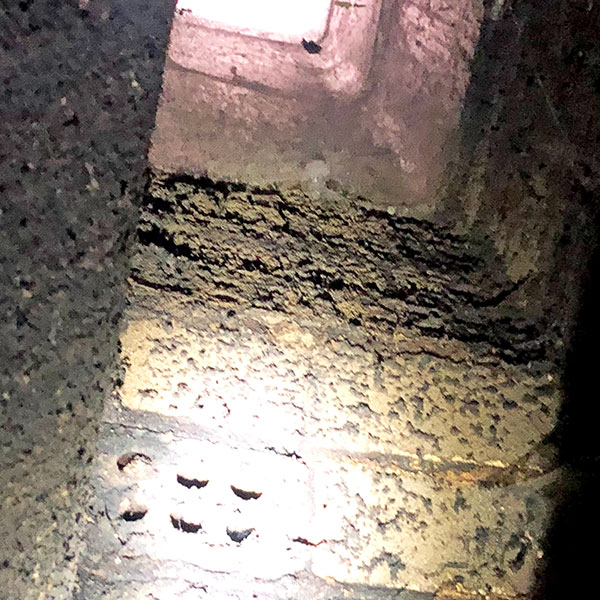
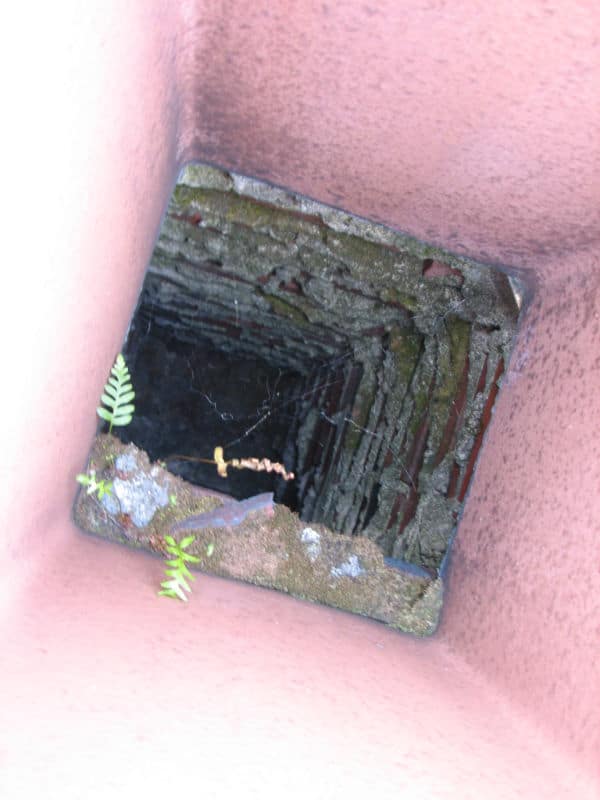
Grab a flashlight and look up into your fireplace. If you can see cracks in the clay tiles lining your flue, or if you’re seeing pieces of tile or masonry falling into your firebox, your liner is actively failing. This isn’t a “maybe we should look at this next year” situation. This is a “we need to address this before we use this fireplace again” situation.
Clay tile liners crack for a bunch of reasons, but in Bristol County the biggest culprit is our freeze-thaw cycle. Water gets into microscopic cracks, freezes, expands, and turns those microscopic cracks into visible ones. Do that enough times over enough winters and eventually the tiles start breaking apart. You’ll see pieces of clay tile in your firebox that definitely weren’t there before.
Sometimes you can see the cracks themselves if you look up from below with a good light. They’ll show up as dark lines running through the tile surface. Other times you won’t see the crack, but you’ll see the evidence—white staining on your chimney exterior, which happens when moisture is getting through damaged mortar joints and bringing minerals to the surface.
Even small cracks are a problem. They let heat escape into the surrounding masonry. They allow corrosive combustion byproducts to attack your chimney’s structure. They create pathways for carbon monoxide to enter your home. And they get bigger over time, especially when you’re using your fireplace regularly and subjecting those tiles to repeated heating and cooling cycles.
If you have a stainless steel liner, visible damage looks different. You’re looking for rust, corrosion, or physical damage like dents or separations at the joints. Rust on a stainless steel liner means moisture has been getting to it consistently enough to overcome the corrosion resistance the material is designed to have. That’s a sign of a bigger problem—usually water intrusion from a damaged chimney cap or crown.
The thing about visible damage is that it’s just what you can see from the firebox. There’s likely more damage higher up in the flue where you can’t see without specialized camera equipment. We use video cameras to examine the entire length of the liner, and we routinely find damage that isn’t visible from below. That’s why a visual check from your living room is just a starting point, not a complete assessment.
If you’re seeing any kind of visible deterioration—cracks, missing pieces, rust, or separation—you need a full inspection before winter. Don’t assume that because you can only see one cracked tile, that’s the only problem. In most cases, visible damage means there’s more damage you can’t see, and the only way to know how bad it really is is to have a professional look at the entire system.
Draft is what pulls smoke up and out of your chimney. When it’s working right, you don’t even think about it. When it’s not, you notice immediately. If your fireplace has suddenly developed draft issues—fires that won’t stay lit, smoke that doesn’t rise, or a system that just feels “off”—your flue liner could be the problem.
A cracked or deteriorating liner disrupts the smooth column of rising air that creates draft. Think of it like trying to drink through a straw with holes in it. The suction doesn’t work properly because air is escaping where it shouldn’t. Same principle applies to your chimney. If your liner has gaps or cracks, cold air from outside can enter the flue at those points, disrupting the temperature differential that creates draft.
Negative air pressure in your home can cause draft problems too, especially in newer, tighter homes. But if your home hasn’t changed and your chimney suddenly can’t maintain proper draft, the liner is often the culprit. This is especially true if the draft problems are inconsistent—working fine some days, terrible others. That pattern suggests physical damage that’s affecting airflow unpredictably.
In Bristol County, cold flue syndrome makes draft problems worse. After months of your chimney sitting unused, cold air settles in the flue like a plug. When you try to light a fire, that cold air has to be displaced before warm air can rise. If your liner is damaged, this process becomes even more difficult because you’re fighting both the cold air and the disrupted airflow from the compromised liner.
You might also notice that draft problems get worse as winter progresses. That’s because freeze-thaw cycles are actively making existing cracks bigger. What started as a small gap in October becomes a significant break by January. Each freeze cycle expands the damage a little more, and draft performance deteriorates along with it.
Poor draft isn’t just annoying—it’s dangerous. When smoke can’t exit properly, it backs up into your home. That means you’re breathing carbon monoxide and other combustion byproducts. It also means creosote is condensing in your flue at higher rates because the smoke isn’t staying hot enough as it exits. More creosote means higher fire risk. It’s a compounding problem that gets worse the longer you ignore it.
If you’re experiencing draft issues, don’t try to solve them with temporary fixes like opening windows or adjusting dampers. Those might mask the symptoms, but they’re not addressing the root cause. Get a professional to inspect your liner and determine whether damage is affecting your chimney’s ability to vent properly. That’s the only way to know for sure what you’re dealing with and what needs to be done to fix it.
Article details:
Share:
Continue learning: