What fireplace maintenance actually looks like in a Massachusetts winter — and why the timing of when you schedule it matters more than most homeowners realize.
Share:

Most fireplace maintenance advice was written for someone in a mild climate with a newer home and a simple setup. If you’re in Norfolk County, that advice leaves out a lot. The freeze-thaw cycle here is relentless. Many homes were built before anyone alive today was born. And the South Shore’s coastal air does things to brick and mortar that a checklist from a national home improvement site won’t mention.
This guide covers what fireplace maintenance actually looks like in Norfolk County — what to check, when to do it, and why the timing of that appointment matters more than most people think.
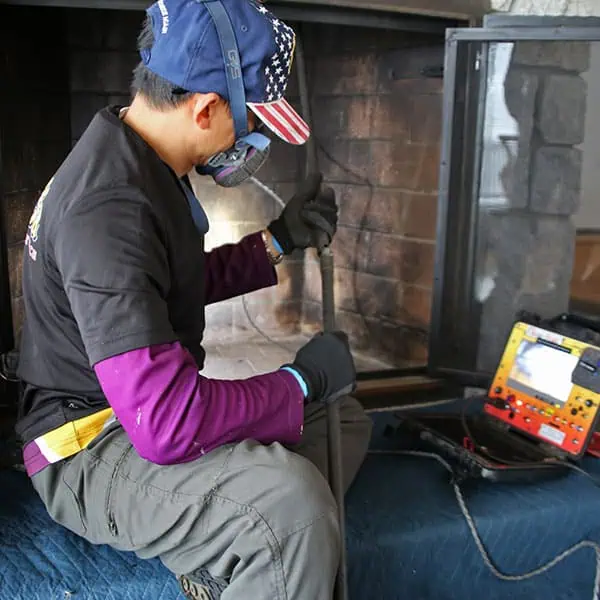
There’s a version of fireplace maintenance that means running a brush down the flue once a year and calling it done. That’s not what we’re talking about here. A proper annual service covers the full system — from the firebox at the bottom to the chimney cap at the top — because problems at any point in that chain can affect everything else.
The sweep itself removes creosote, soot, and any debris that’s made its way in. But the inspection that runs alongside it is where the real value lives. That’s when we look at the liner, the smoke chamber, the damper, the crown, the flashing, and the masonry — not just to confirm they’re present, but to assess their condition and flag anything that’s getting worse.
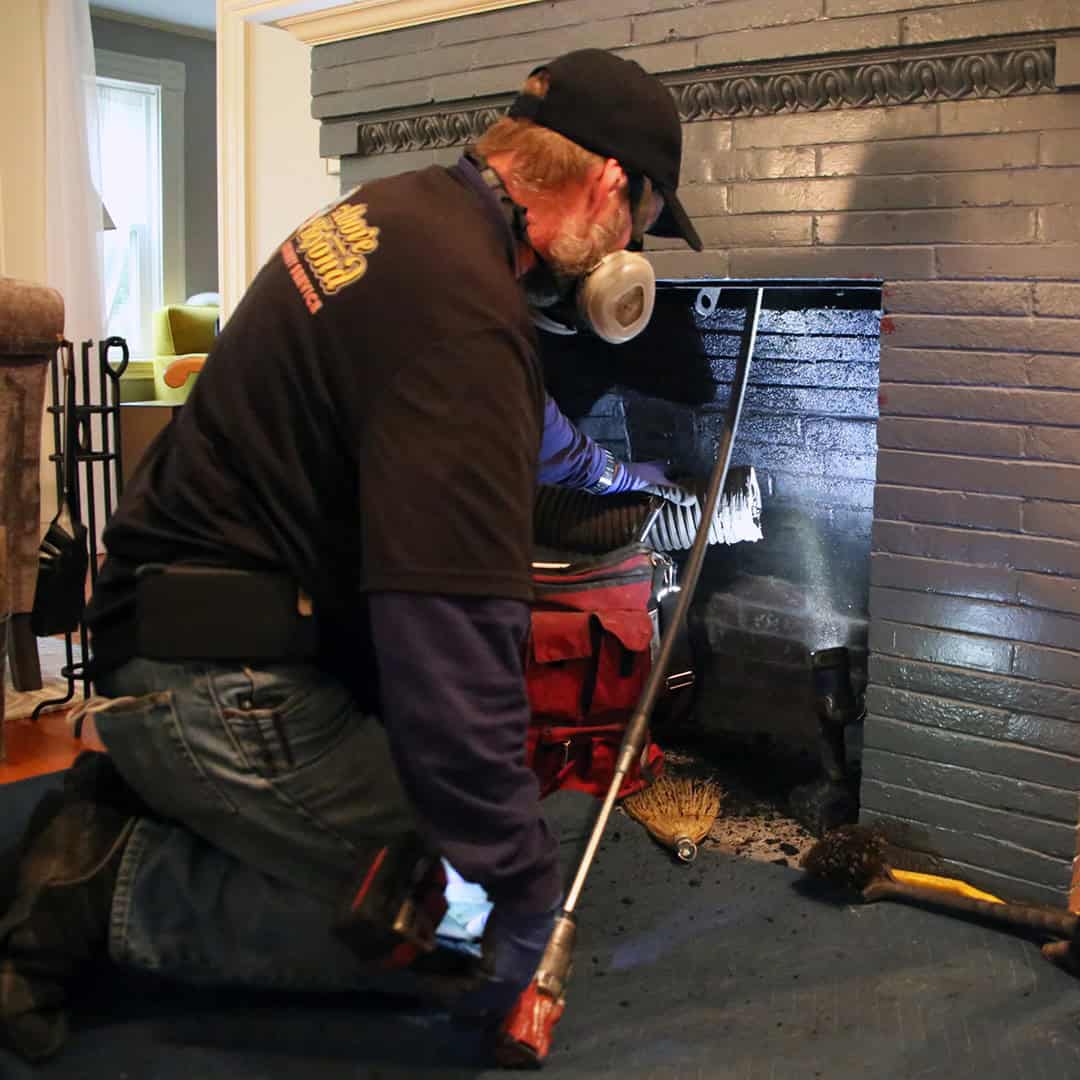
Creosote is the byproduct of burning wood. Every fire leaves some behind, and it accumulates on the walls of your flue over time. What most homeowners don’t realize is that creosote isn’t one thing — it progresses through three distinct stages, and the stage it’s in determines what kind of service you actually need.
Stage 1 is light and flaky. A standard chimney brush handles it without much trouble. Stage 2 is harder and tar-like, and it requires more specialized tools to remove. Stage 3 — sometimes called glazed creosote — is dense, shiny, and extremely difficult to clear. At that point, chemical treatment or liner replacement may be the only real option.
This matters because most homeowners assume a chimney sweep is a chimney sweep. But if you’ve got Stage 2 or Stage 3 buildup and the technician only brought equipment for Stage 1, you’re leaving the appointment thinking the job is done when it isn’t. A proper inspection identifies the stage first, then the service is scoped accordingly.
You can’t assess creosote stage from inside your home. You can’t see the flue walls, you don’t have the lighting, and you don’t have the reference point to know what’s normal and what isn’t. This is one of the clearest reasons annual professional maintenance exists — not because the industry says so, but because the information genuinely isn’t accessible to you without the right equipment and training.
Even if you barely use your fireplace, you’re not off the hook. Animals nest in unused chimneys. Debris falls in. Moisture works its way into hairline cracks in the liner. A fireplace that sat dormant all winter still needs to be looked at before you light it again.
This is one of the most common assumptions we run into: gas fireplaces don’t produce creosote, so they don’t need maintenance. The first part is true. The second part isn’t.
Gas fireplaces still vent combustion gases through a flue, and that flue can get blocked — by bird nests, debris, or deteriorating components — just like a wood-burning system. When the vent is partially blocked, combustion gases don’t exit the way they’re supposed to. Carbon monoxide is the concern here. It’s colorless and odorless, and in a well-insulated New England home, it doesn’t have many places to go.
Beyond the venting, gas fireplaces have components that wear over time: the thermocouple, the ignition system, the burner, the glass seal. None of these announce when they’re starting to fail. Annual maintenance catches wear before it becomes a problem — or before it becomes a repair that costs significantly more than an inspection would have.
The CSIA recommends annual inspection for all fireplaces, gas included. NFPA 211, the governing standard for chimney and fireplace systems in the United States, says the same thing. These aren’t arbitrary recommendations. They exist because the failure modes in these systems are largely invisible until something goes wrong.
If your gas fireplace hasn’t been looked at in a few years, it’s worth scheduling before you need it. Not because something is necessarily wrong — but because you genuinely can’t know that without having someone check.
Generic fireplace maintenance advice doesn’t account for what a Massachusetts winter actually does to a chimney. Norfolk County homeowners are dealing with conditions that accelerate wear in ways that homeowners in milder climates simply don’t experience at the same rate.
Two factors stand out. The first is the freeze-thaw cycle. The second is the age of the housing stock. Together, they mean that a chimney in Cohasset, MA, Medfield, MA, or Norwood, MA often has a more complicated maintenance picture than the national averages suggest.

A Norfolk County winter doesn’t stay cold. Temperatures move above and below freezing dozens of times between October and March. Every time that happens, any water that’s found its way into a small crack in the mortar or brick expands as it freezes, then contracts as it thaws. Do that enough times, and a hairline crack becomes a visible gap. A visible gap becomes a structural issue.
This process — called spalling — is gradual and largely invisible from the ground. You might notice a few chips of brick or mortar near the base of the chimney. You might not notice anything at all until a piece of the crown breaks away or water starts showing up in places it shouldn’t. By the time it’s visible, the damage has usually been building for more than one season.
The communities along the South Shore — Cohasset, MA, Weymouth, MA, Braintree, MA, Quincy, MA — add another variable: coastal air. Salt accelerates the deterioration of mortar. A chimney two miles from the water weathers differently than one inland, and maintenance intervals should reflect that.
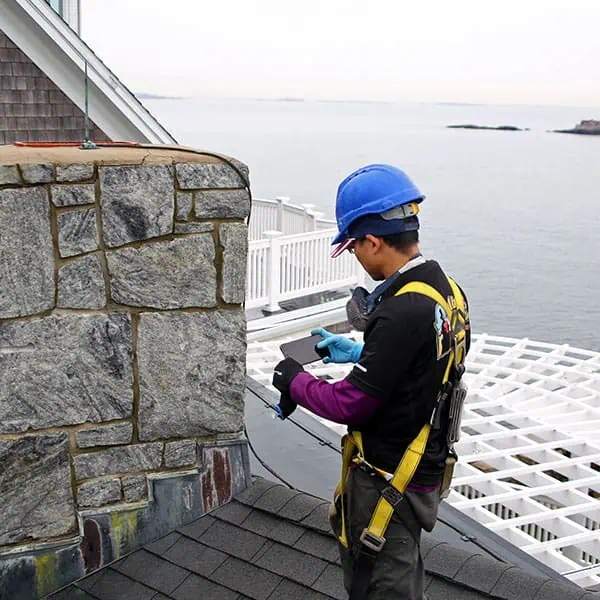
Fireplace maintenance in Norfolk County isn’t just about the interior of the flue. The crown, the flashing, the mortar joints, and the cap all matter — because water is the primary long-term threat to a chimney system, and all of those components are the first line of defense against it. A sweep that ignores the exterior condition of the chimney isn’t giving you the full picture.
We work across Norfolk County and see this pattern regularly. Homes in Medfield, MA, Sherborn, MA, Dover, MA, and Walpole, MA — many of them built well before World War II — often have original masonry that’s been patched over the years but never comprehensively assessed. The maintenance conversation for those homes is different than it is for a chimney installed in 2005.
This comes up constantly. You bought the house, the general home inspector noted the chimney was “functional” or “beyond the scope of this inspection,” and now you’re the one responsible for figuring out what condition it’s actually in.
You need a dedicated chimney inspection, not a sweep. A sweep cleans what’s there. An inspection tells you what’s there and what condition it’s in. Those are different services, and if you don’t know the history of the chimney, the inspection is where you start.
A Level 1 inspection covers the accessible portions of the system — the firebox, the damper, the visible flue, the exterior above the roofline. It’s appropriate when there’s no known change to the system and no specific reason to suspect structural damage. A Level 2 inspection goes further and includes a video scan of the flue interior. If you’re a new homeowner with no maintenance records, Level 2 is often the right call — because it gives you documentation of the liner’s condition, which matters both for your own peace of mind and for insurance purposes.
What we find in older Norfolk County homes fairly often is clay tile liners that have cracked or separated over time. These liners were standard for decades and they’ve held up reasonably well, but they don’t last forever. When they fail, they create gaps where combustion gases — including carbon monoxide — can escape into the wall cavity rather than exiting through the top of the chimney. That’s not a theoretical risk. It’s a documented failure mode in older liner systems.
The good news is that a liner issue found during an inspection is a solvable problem. Liner replacement is one of the most common services we do across Norfolk County, and it’s straightforward when it’s caught before there’s collateral damage. The less good news is that it’s not something you’d find on your own — which is exactly why the inspection matters.
If you’ve moved into a home in Norwood, MA, Franklin, MA, Wrentham, MA, or anywhere else in Norfolk County and you’re not sure when the chimney was last serviced, don’t wait until you want to use the fireplace in November to find out. Fall is the busiest time of year for chimney services across Greater Boston. Appointments that are easy to get in August become three-week waits by mid-October.
Schedule before fall. Not because it’s a rule, but because it’s practical. Once October arrives, every chimney company in the region is backed up. Scheduling in August means you get the appointment time you want, the technician isn’t rushing between jobs, and your fireplace is ready well before you actually need it.
Annual fireplace maintenance in New England isn’t optional maintenance — it’s the kind of thing that prevents expensive repairs, keeps your system running efficiently, and gives you real information about what’s happening inside a part of your home you otherwise can’t see.
If you’re in Norfolk County and you want a team that handles the sweep, the inspection, and any masonry work that comes up — all in one visit — we’re here to help. You can reach us by phone at 1-781-635-9582 or by text if that’s easier.
Article details:
Share:
Continue learning: